
Singapore | Hong Kong | Dubai
Ruby
The King of Gems - Passion, Power, and Priceless Fire
Sixty Ventures dedicated Gold & Gems. Your global reference for the world’s most coveted treasures. Starting with ruby – the stone that has ignited desire for over 2,000 years.
Imagine a gem so vivid it seems to pulse with its own heartbeat. A single glance and you understand why ancient Burmese kings called the finest rubies “the face of God.” Why queens wore them into battle for protection. Why today, in 2026, untreated Burmese “pigeon blood” rubies are shattering auction records while supply from Myanmar’s legendary mines has all but vanished due to geopolitical realities.
This is not just another gem page. This is your no-fluff, expert guide to every type of ruby on Earth – with the Burmese variety taking centre stage as the undisputed champion. Whether you’re a collector, investor, or simply someone who wants to understand why these stones command six-figure prices per carat, you’re in the right place.

What Is Ruby? The Science of Pure Fire
Ruby is the red variety of the mineral corundum (aluminium oxide, Al₂O₃). Trace amounts of chromium create that legendary red hue – the more chromium and the purer the red, the more valuable the stone. On the Mohs scale, ruby scores a 9 – second only to diamond in hardness. It’s tough, brilliant, and built to last centuries.
Rubies form deep in the Earth under extreme heat and pressure, usually in marble or basalt deposits. The result? Stones that literally glow from within thanks to strong red fluorescence under UV light – a signature trait of the very best examples.
Birthstone for July:
• Symbol of passion, prosperity, courage, and vitality
• Mentioned in the Bible and ancient Sanskrit texts as the “king of gems.”
Not all rubies
are equal.
By Type
-
Natural Rubies – Mined from the Earth. The gold standard.
-
Treated Rubies – Heat-treated (most common) to improve colour and clarity. Still natural, just enhanced.
-
Untreated Rubies – Extremely rare and command massive premiums – especially from Burma.
-
Synthetic (Lab-Grown) Rubies – Chemically identical but created in controlled conditions. Affordable and flawless-looking.
-
Star Rubies – Display a six-rayed “asterism” (star) caused by microscopic rutile needles (“silk”). The most famous are from Sri Lanka and Burma.
-
Pink/Reddish-Pink Rubies – Often from Sri Lanka or Madagascar; still classified as ruby if the hue is primarily red.
-
Trapiche Rubies – Rare “wheel” pattern inclusions that look like a star from above.
By Origin (the biggest value driver):
-
Burmese (Myanmar) – The benchmark. Mogok (“Valley of Rubies”) and Mong Hsu mines.
-
Mozambican – Vibrant, often cleaner, but usually lack the iconic blue undertone.
-
Thai – Darker, brownish-red tones.
-
Madagascan & African – Newer sources offering beautiful colour at more accessible prices.
-
Sri Lankan – Often pinker with excellent clarity.

Burmese Ruby: The Undisputed King
“Pigeon Blood” Perfection
If there’s one ruby that makes hearts race worldwide, it’s the Burmese pigeon blood ruby.
Why “pigeon blood”? In old Burma, locals compared the finest stones to the first drop of blood from a freshly killed pigeon – a vivid, saturated red with a subtle blue undertone that gives insane depth and fire. Under the right light, these stones actually fluoresce, making them appear to glow from within.
Famous Burmese Rubies That Made History
-
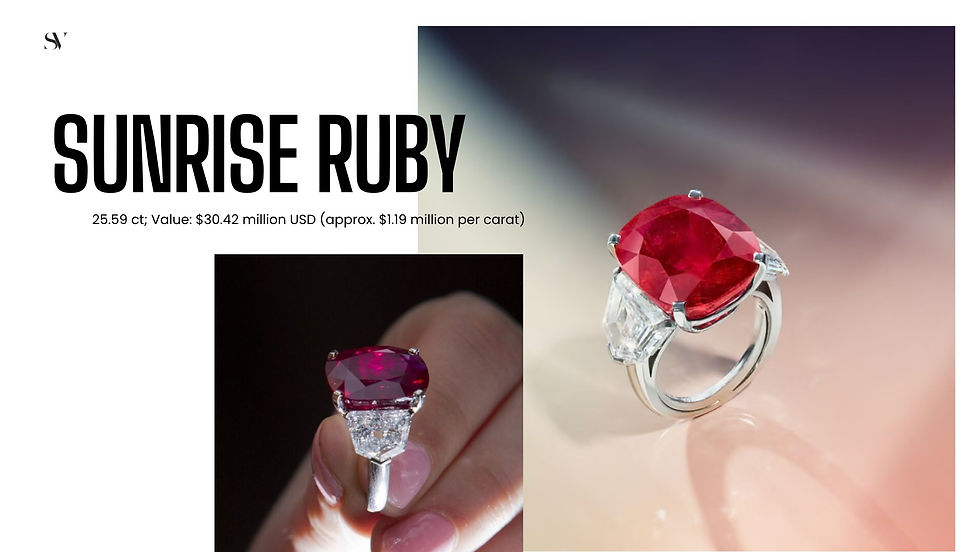
Sunrise Ruby (25.59 ct) – Sold for record-breaking millions.
-
Carmen Lúcia Ruby (23.10 ct) – One of the largest and finest faceted Burmese rubies, now in the Smithsonian.
-
Graff Ruby (8.62 ct pigeon blood) – Once the most expensive ruby ever sold.
-
Queen Elizabeth II’s Burmese Ruby Tiara (96 stones).
-
Elizabeth Taylor’s Cartier ruby suite – all untreated Burmese.


The 4Cs of Ruby (Why Colour Reigns Supreme)
Unlike diamonds, colour is king in rubies:

Mogok, MYANMAR

Pro tip: Always demand a GIA or equivalent lab report. “Pigeon blood” is not a universal term – GIA and Gübelin have strict criteria.

How to Spot a Real Ruby (and Avoid Fakes)
-
Real rubies feel heavy for their size, have natural inclusions (silk, crystals, feathers), and often fluoresce red under UV.
-
Glass or synthetic may look too perfect, show gas bubbles, or have unnatural colour zoning.
-
Lead-glass filled stones can crack or change colour over time.
-
Scratch test: Ruby scratches glass easily but not sapphire.
Care tips: Ultrasonic cleaners are usually safe, but avoid sudden temperature changes. Store separately to prevent scratches.
Ruby as Investment & Legacy (Why Sixty Ventures Exists)
In 2026, rubies – especially untreated Burmese – are outperforming many traditional assets. Limited new supply + surging demand from Asia and high-net-worth collectors = strong appreciation potential.
Whether you’re building a collection, hedging with tangible luxury assets, or simply acquiring a piece that will be treasured for generations, Burmese ruby stands alone.
Ready to own a piece of the legend?
Sixty Ventures connects elite buyers and sellers with verified, GRS-certified rubies and other high-value gems through our trusted global network.


